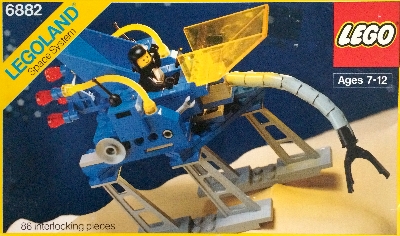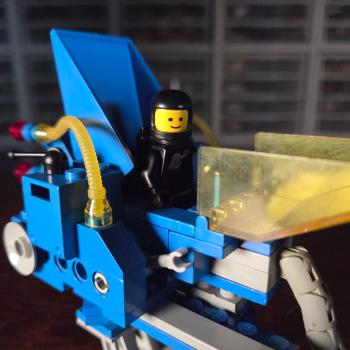
My childhood copy of 6882, rebuilt in 2026. The claw still gets all the attention, but it's the legs that hooked me.
I loved Space and I loved Castle almost equally as a kid, and almost nothing I owned stayed in the box it came in. I merged sets, grafted parts from one onto another, and turned finished models into raw material for whatever I was building next. Walking Astro Grappler (6882) is one of the sets that survived that treatment mostly intact anyway, because it did something none of my other pieces could do: it walked. Not rolled, not slid on skis like half the Space line did. It slid its feet.
I could sit and cycle that thing across the carpet for longer than any 88-piece set has a right to hold a kid's attention. This is one of two "walkers" I owned as a kid, the other being Alien Moon Stalker (6940), and decades later it's still one of the most memorable Space sets from my childhood collection.
At a Glance
- Name
- Walking Astro Grappler (6882-1)
- Category
- Space › Classic Space
- Released
- ~ 1985
- Lifespan
- 1985 ~
- Pieces
- 88
- Minifigures
- 1
- MSRP (US)
- $/piece
- $0.170
- BrickLink new
- $488.75
- BrickLink used
- $40.00
- ROI vs MSRP
- +3161%
Classic Space Before It Needed a Last Name
In 1985, "Space" didn't need a qualifier. There was no Blacktron, no Ice Planet, no Ice anything. There was just the blue and gray and trans-yellow toybox we now call Classic Space, and it covered everything from single-minifig scooters to sprawling command bases. A walking robot was a genuine oddity in that lineup. Most Space vehicles in 1985 rolled on wheels or sat on skis. This one stood up on four legs and a grappler arm, and that alone made it feel like it came from a different, stranger corner of the catalog.
I built plenty of my own Technic creations. I just never played with them the way I played with Space and Castle. Technic was something I built and experimented with, testing a mechanism, seeing what a gear ratio or a linkage actually did, then moving on. It never got a backstory. The Astro Grappler split the difference for me. It lived in my Space bin and got played with like a Space set, but the legs were pure Technic under the hood, and I spent as much time working that hip joint by hand, studying how it moved, as I did flying the thing across imaginary moonscapes.
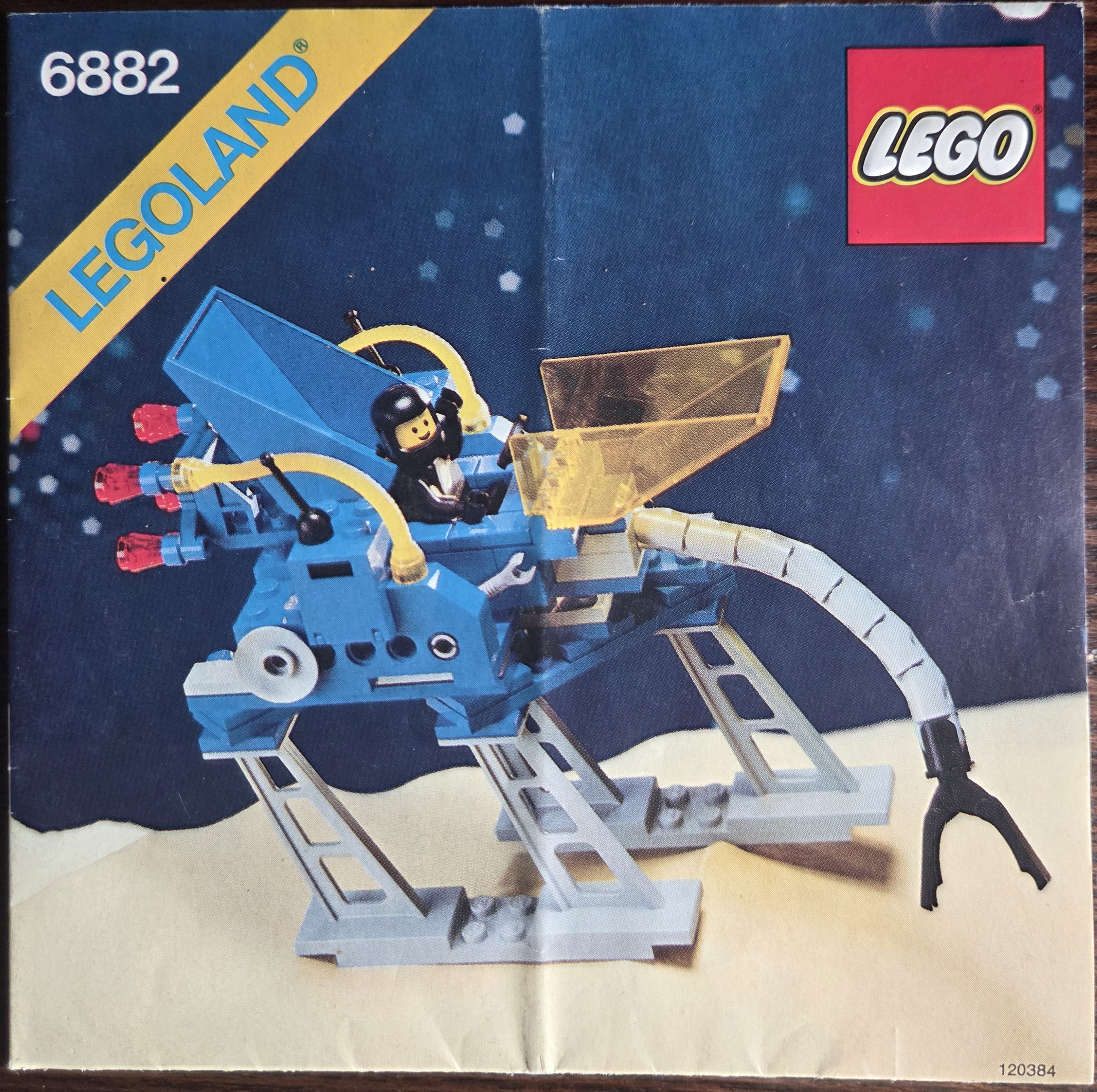
The box and my childhood instructions are long gone. This booklet is a replacement I bought on BrickLink, and the cover art still sells the fantasy: something out there needs grappling.
The Build
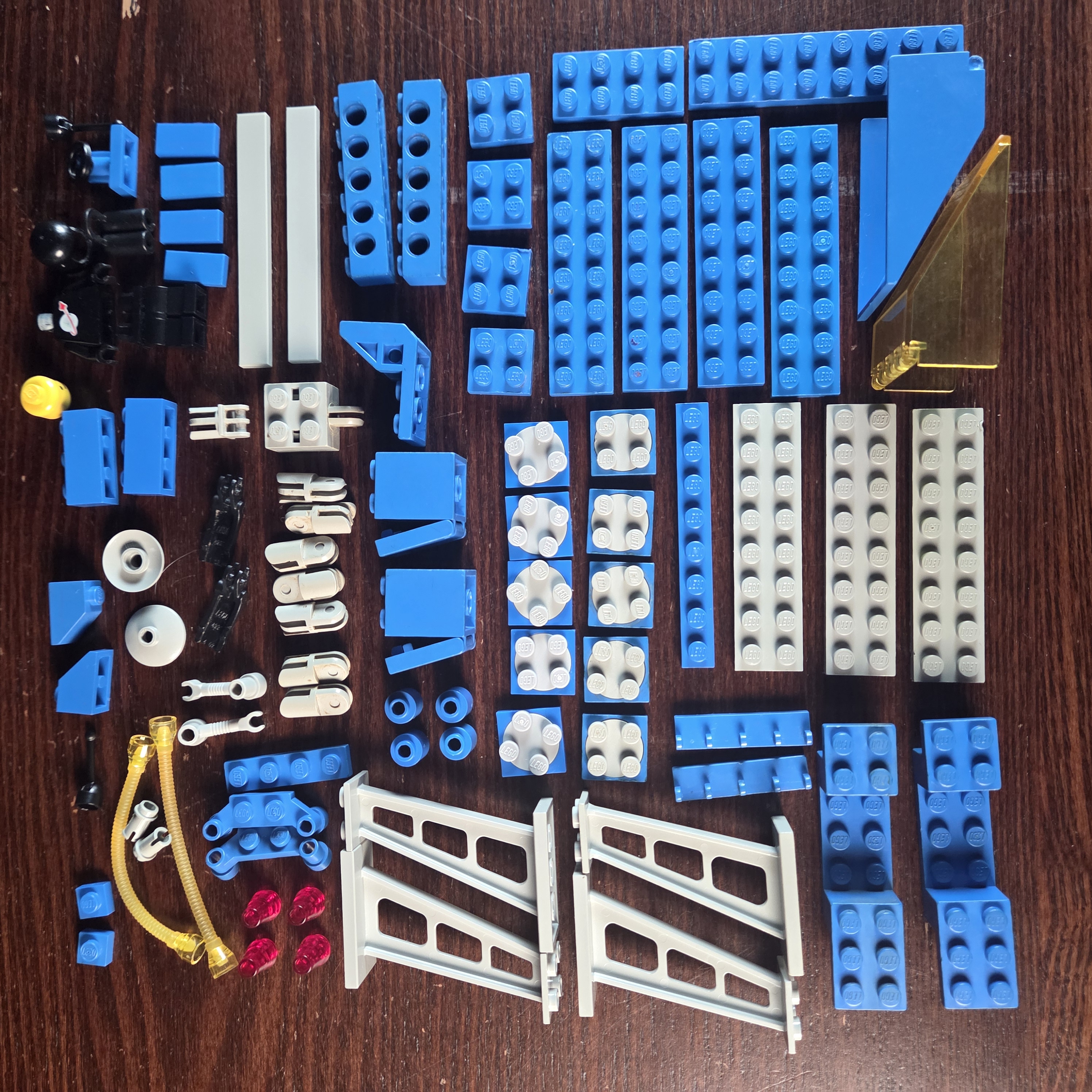
All 88 pieces, sorted. Almost everything here is either a leg part or a Technic joint. This set spent its whole budget on the walk.
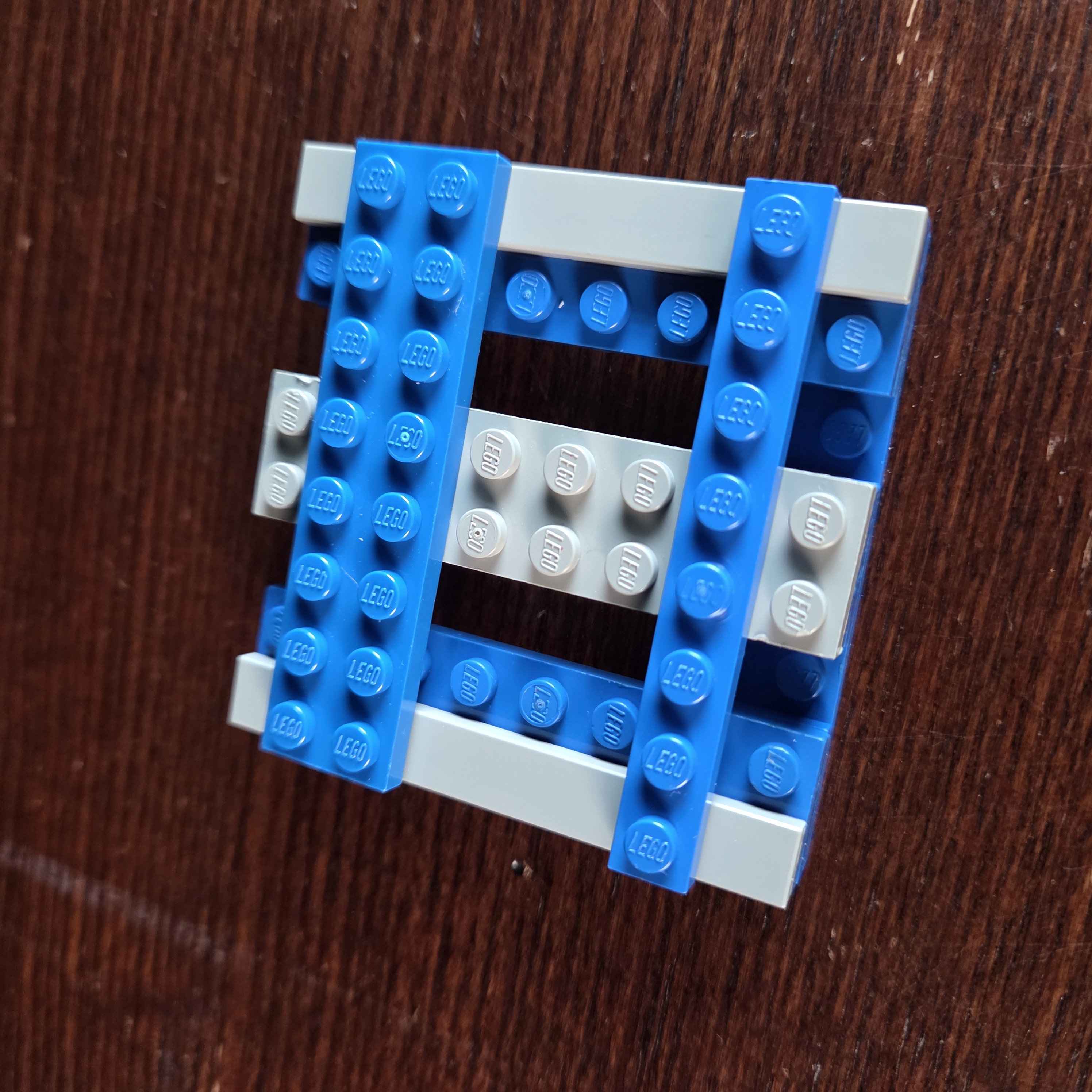
At 88 pieces this is a short build, but it's a dense one. Roughly half the parts go toward the four identical leg assemblies, and each leg is its own small Technic exercise: a girder-style upper frame, a hip built around a 2x2 turntable, and a light gray foot that splays out into a stable stance. Build one leg and you understand the whole set. Build the other three and you start to appreciate how much repetition it takes to make four legs move in a way that looks remotely convincing.
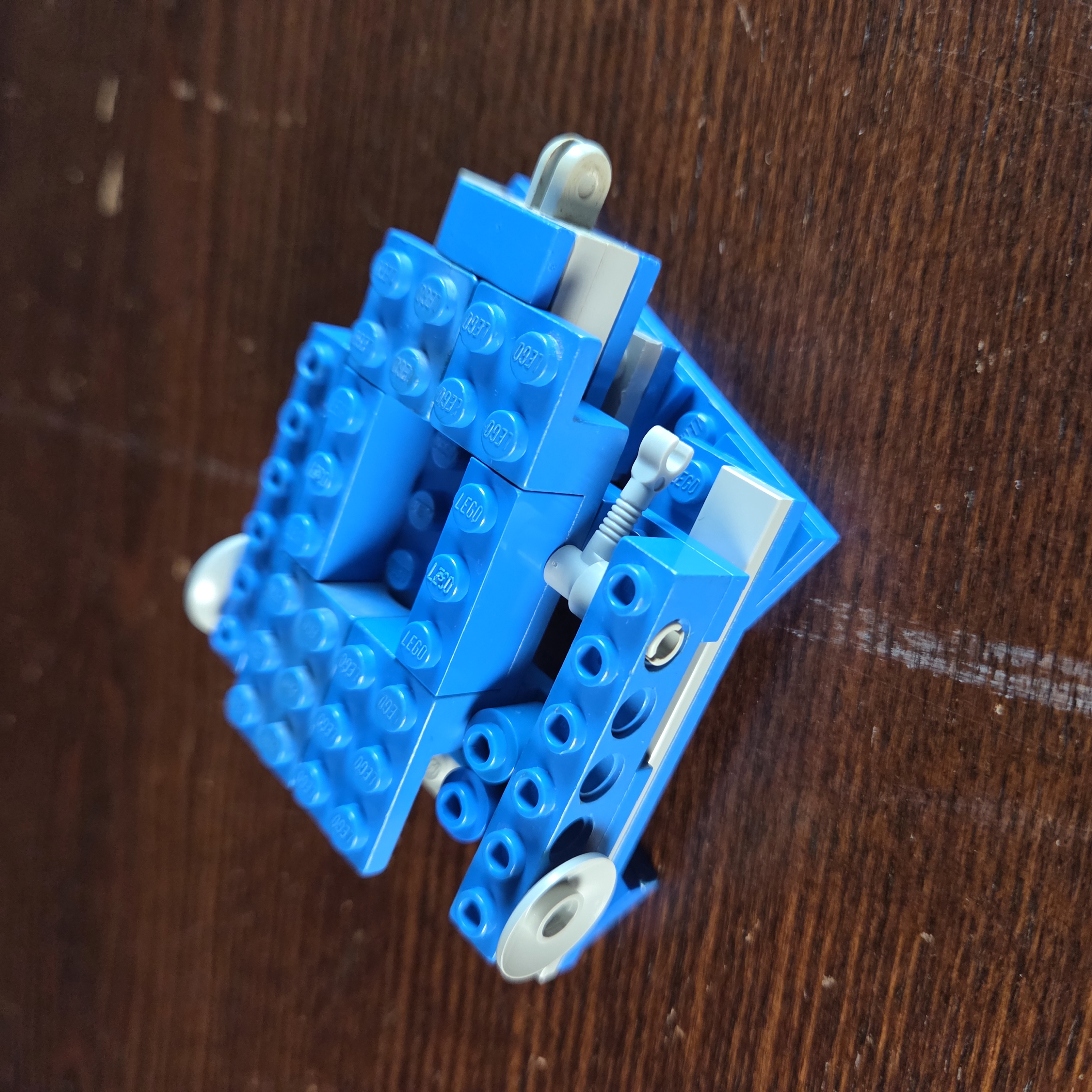
The hip joint mid-build. That turntable is the entire trick. Everything the legs do traces back to this one part.
The turntable hip is the reason this set stuck with me. It's not motorized and it's not automated. You move the legs by hand, one at a time, and the turntable lets each leg swing and twist in a synchronous motion instead of just hinging back and forth like a door. Watching all four resolve into a stable four-point stance after I'd been fidgeting with them one by one was, for eight-year-old me, genuinely a little bit like magic. I didn't have the vocabulary for "articulation" yet. I just knew I could make a spaceship walk, and I could not stop doing it.
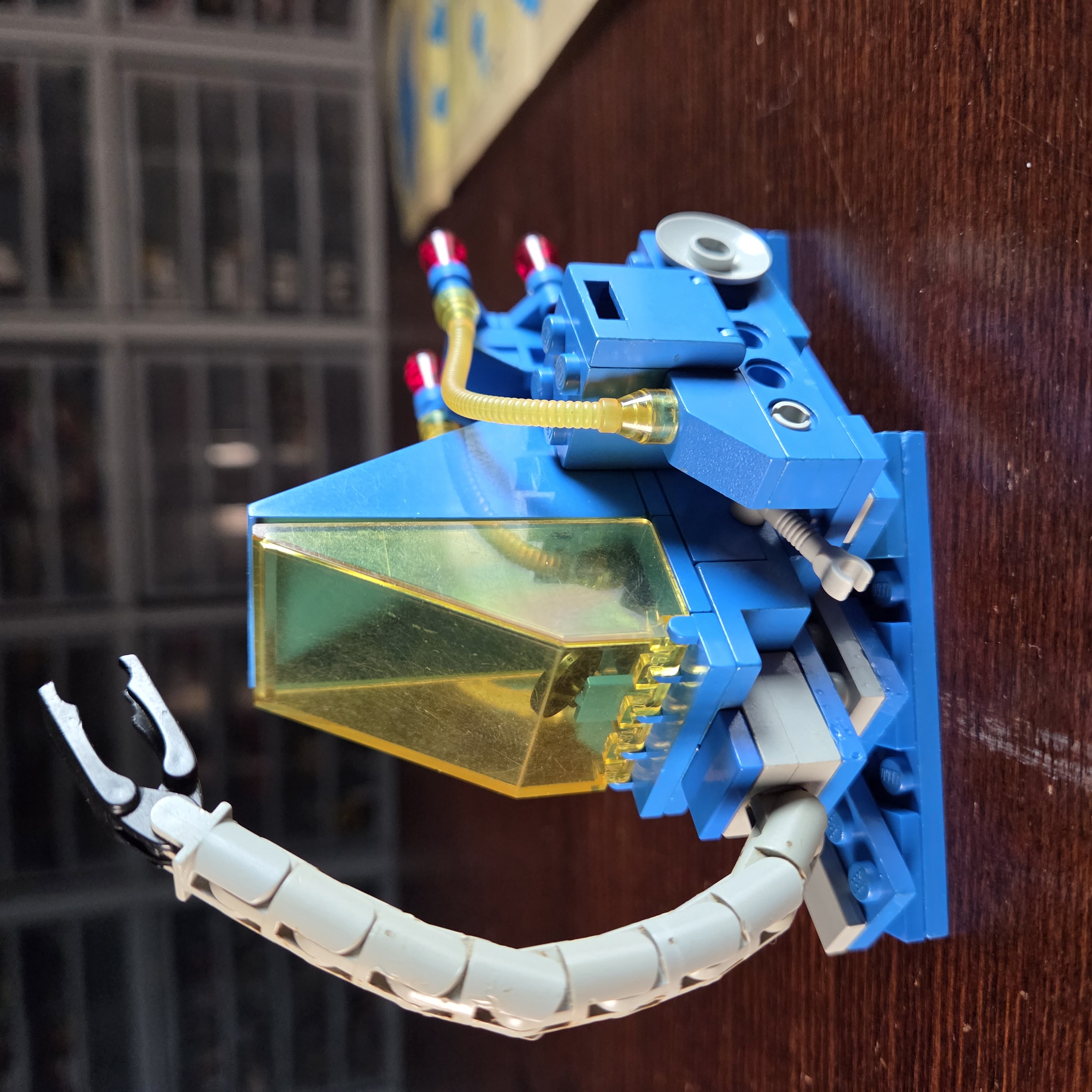
The body, essentially finished, still waiting on its legs. Cab, thrusters, and claw are all here. This is the set's whole personality in one photo.
The rest of the build is the fun kind of greebly: four trans-red 1x1 cones on flexible yellow hoses that read as thrusters or maybe weapons, a translucent yellow windshield wedge that turns a Technic skeleton into an actual cockpit, and the namesake grappler, a light gray accordion hose ending in a black claw that swings forward independent of everything else. None of it is structural. All of it is exactly what makes the set worth building.
My own instructions didn't make it out of the 1980s. This booklet is a replacement I bought on BrickLink as an adult, and I'm glad I did. Rebuilding from a stranger's old photocopied fold-out felt closer to the original experience than rebuilding from a slick modern reprint would have.
The Minifigures
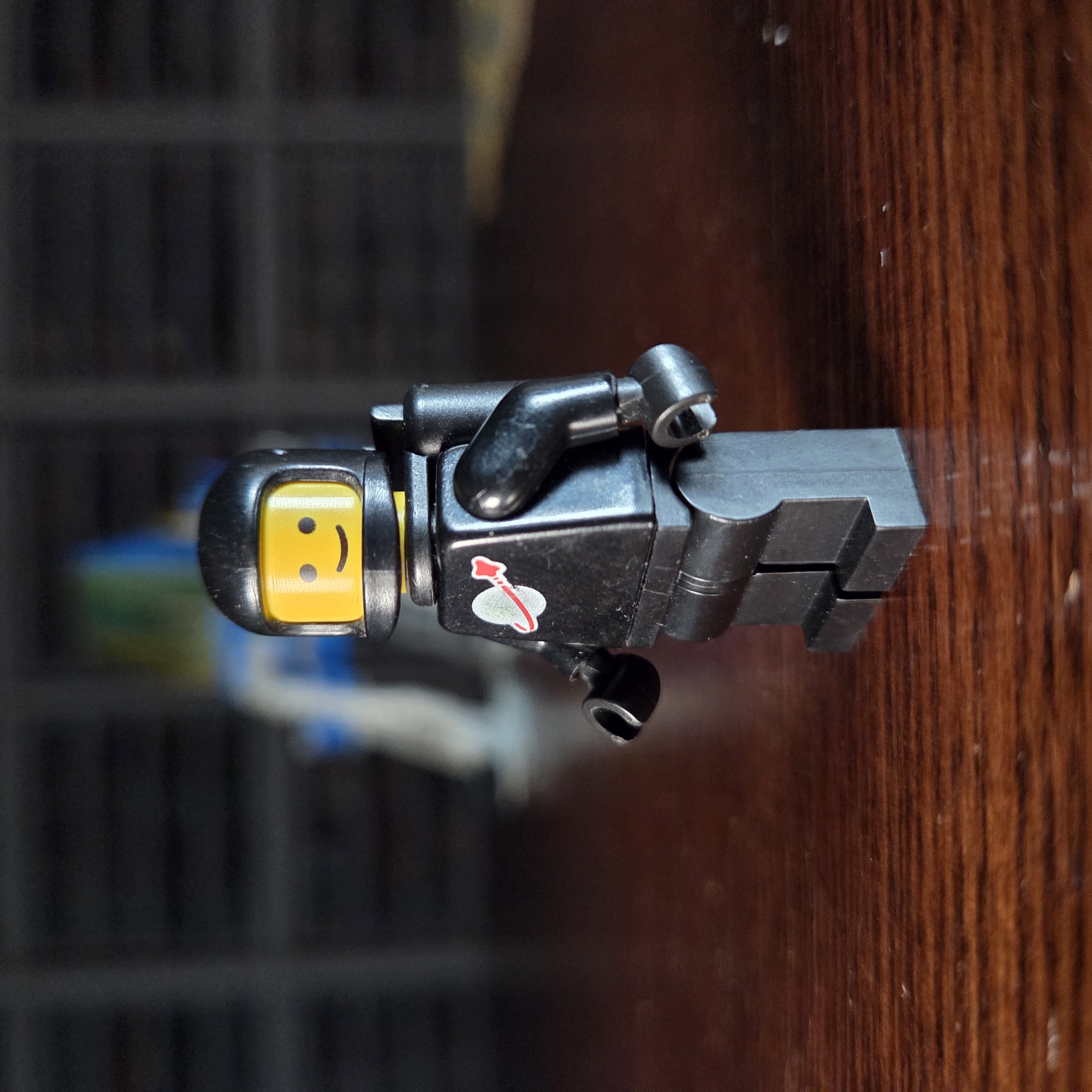
The pilot. One astronaut, one wrench, and a job that mostly involves standing very still while the legs do the interesting work.
You only get one minifigure here, a black Classic Space astronaut, and in an 88-piece set that's not a complaint, it's just the math. Black was one of the six original Classic Space suit colors, and next to the white and red astronauts that showed up in bigger sets, black always felt a little more serious to me.
There's a small production detail worth calling out for anyone who collects this era closely. This particular head is element 3626ap01, the standard grin print on a solid stud, meaning there's no hole through the top of the head. The far more common version most collectors know is 3626p01, which has a hollow stud. It's an easy thing to miss unless you're looking for it, and it's the kind of detail that dates a minifigure to a specific slice of production more precisely than the box ever could.


6882 was one of two walkers in my childhood collection, the other being Alien Moon Stalker (6940). I'm saving the full story of that one for its own review. This one earns its place on its own.
Why Space and Castle Never Mixed
Here's something I still can't fully explain. I merged and modified almost everything I owned. Castle wall sections ended up holding up Space landing pads. Space cockpits got grafted onto things that had no business flying. But Space and Castle themselves, as categories, never crossed. My astronauts never explored the King's Castle. My knights never found a wrecked spaceship in the woods behind the moat. It wasn't a rule anyone told me. I don't remember ever deciding it. It just never happened, and looking back, that's strange, because I had no such boundary anywhere else.
It wasn't storage keeping them apart. All my pieces mixed together in the same bins, gray castle stone jumbled in with blue and trans-yellow Space parts, so I could always have grabbed both at once if I'd wanted to. I never did. My best half-theory is texture, or maybe genre. Castle was matte and grounded, heraldry and stone. Space was shine and implausible geometry, all chrome antennae and colored plastic. Maybe eight-year-old me filed them as different kinds of pretend, the way you wouldn't mix a pirate story into a courtroom drama even if both were just make-believe. That the pieces were right there next to each other the whole time and still never crossed over is what makes the boundary feel real to me now, not imagined after the fact.
I don't have a tidy answer. I'm mostly writing this down because building 6882 again, forty years later, made me notice the gap for the first time. Some questions about your own childhood only show up once you're old enough to ask them, and that's honestly a big part of why I love this hobby. It's never just the plastic. Rebuilding an old set stirs up memories and questions I didn't know I still had, and I don't get that from anything else on my shelf.
How It Holds Up
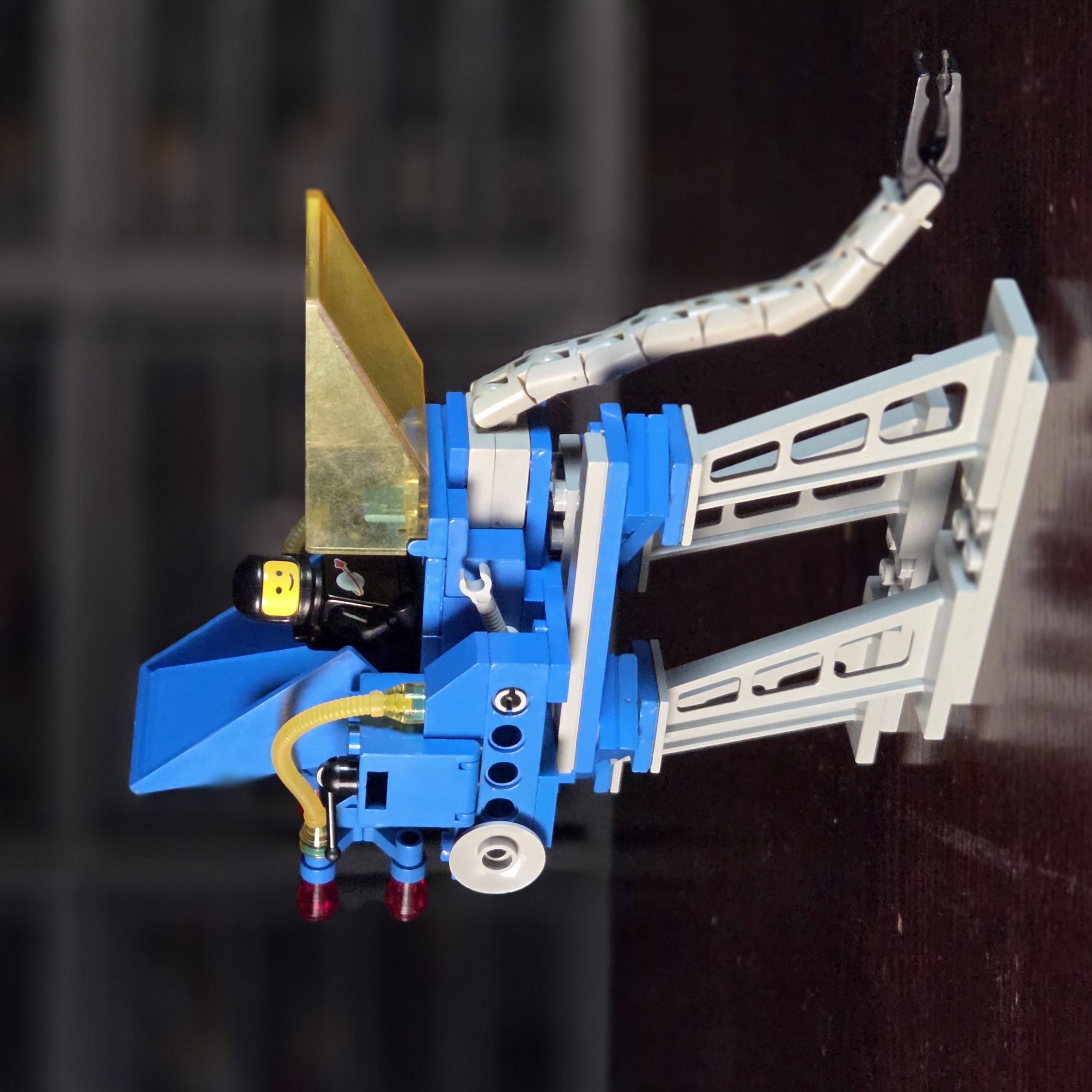
Forty years on, the turntable hips still move freely and the stance still holds. The claw still swings on command.
The leg mechanism is the part that has genuinely aged the best. The turntables still turn smoothly, the stance is still stable on a flat surface, and the whole appeal of the set, the walking itself, works exactly as well today as it did in 1985. That's not something I can say about every mechanical gimmick from this era.
What hasn't aged as well is the fragility of the flexible hose pieces. The yellow thruster hoses and the gray grappler hose are both showing their age, a little stiffer and a little more prone to kinking than they were when new, which is typical for LEGO's rubber and early flex-hose elements from this period. And with only 88 pieces and one minifig, there's less here to sustain attention than in bigger sets from the same year. This was never meant to be a long build. It was meant to be a long play session, and on that measure it still delivers.
Collector's Corner
Sealed copies of 6882 run in the neighborhood of $400, with used copies closer to $40, as of this writing. Values vary more than usual between tracking sites for this one, likely because so few complete examples change hands, but that range holds across the sources I checked.
If you're buying used, the flexible hoses are the first thing to inspect. Both the thruster hoses and the grappler arm hose are prone to cracking or losing their bend over four decades, and they're the pieces most likely to be missing or swapped on a "complete" listing. The trans-red 1x1 cone thrusters are worth a close look too. The originals here are element 4589, the plain "Cone 1 x 1" with no groove around the top edge. LEGO later revised the mold into 4589b, "Cone 1 x 1 with Top Groove," specifically to relieve stress on the plastic at that point of the piece. If your set's cones have that groove, you're not looking at 1985 production, or the cone has been swapped somewhere along the way. Neither is a dealbreaker, but it's worth knowing which one you're holding.

Check the leg turntables too, and I say that from experience. Five of the blue turntables in my own copy turned out not to be original when I sat down to inspect it for this review. They work fine, they just aren't period-correct, and sourcing five matching replacements is still on my to-do list. Consider this a live example of the kind of quiet part-swapping that happens to a set over forty years of play, long before anyone thinks to call it a "restoration."
That same instinct is why I've made a point of hunting down original pieces wherever I can, instead of just swapping in fresh reproductions. It's why the little gray dish I still think of as the moon has gone faded and a touch yellowed instead of staying bright, and why some of the other pieces are visibly worn at the edges. I could replace every one of them with mint parts from a bag of new old stock and make this set look factory-fresh. I don't want to. That wear is what forty years of being loved actually looks like, and replacing it would mean erasing the only proof this set has that it was played with, not just owned.
Where this review actually happened. The instructions on the table are the BrickLink replacement; the originals never made it out of childhood.
Verdict
- Build experience: 7/10
- Minifigures: 6/10
- Playability: 8/10
- Value (then): 9/10
- Nostalgia: 10/10
- Overall: 8/10
Walking Astro Grappler (6882) is a small set that spent its entire piece budget on one mechanism, and it was the right call. The claw gets the name, but the legs are the reason I never put this thing down as a kid, and the reason I picked it back up forty years later without a second thought.
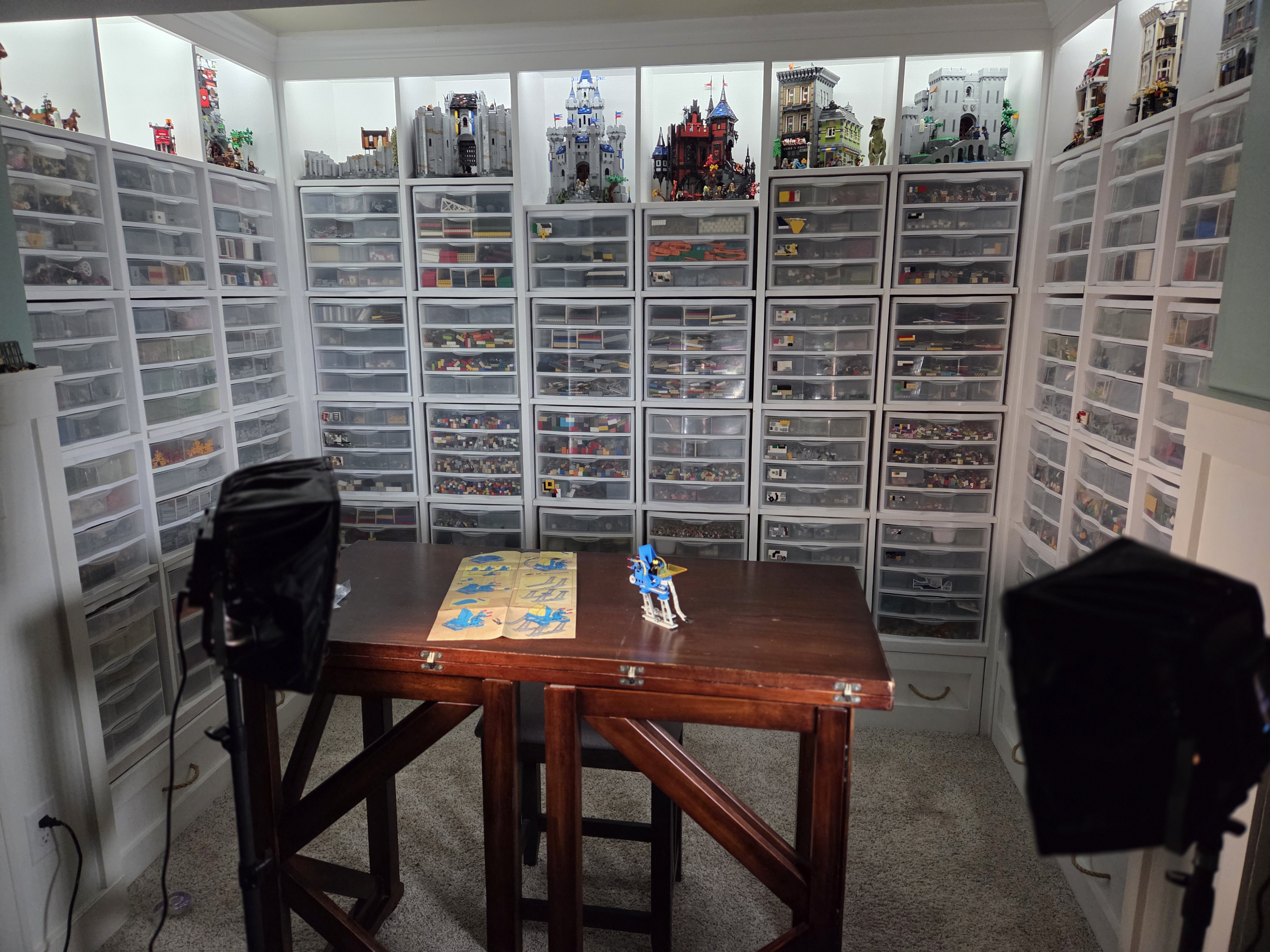
Ninety-two pieces, standing in front of everything they eventually grew into. It still walks. That's still the whole point.
Two space walkers made it through my childhood. This is the first one I've written about, and it earned that spot honestly.
Tracking your own Space collection? Add 6882 to your shelf on SetShelf and see what your childhood is worth these days.